Over the past year, People’s Voice Media have worked with Thera Scotland to gather lived-experience stories reflecting on the importance of accountability in adult social care in Scotland.
Members, volunteers and caregivers from Thera spoke with friends and family about their experiences and what improvements could be made to the system.
These conversations were curated into a video and shared at a conversation of change event on the 29th of June 2026 to raise awareness and support advocacy and service improvement.
We will be sharing the film publicly over the next couple of weeks so watch this space!
We’re big fans of projects that really showcase the versatility of Community Reporting, and those that put communities and people at the heart of local decision-making in truly meaningful ways. So, you could say that working as evaluation partners on Bristol City Council’s Community Resilience Fund was a dream collaboration for People’s Voice Media. Read on to find out more about this people-powered project that put funds into the hands of grassroots local organisations, and how we used lived experience methodologies to assess its impacts.
Bristol City Council’s (BCC) Community Resilience Fund was a £4m grant fund designed to support community organisations with capital works, especially those that challenged power imbalances in the most deprived communities by improving accessibility, sustainability or offering other future-proofing benefits. The council worked very hard to ensure that people from the local community had a say in where the funding went, how it was allocated and how it was spent. This included having a panel of 100 community experts acting as “resident decision-makers”, supported by local councillors and experts in sustainability, accessibility and capital works. Community and voluntary groups seeking funding were guided through the grant-making process by the BCC Communities Team and by capacity-building organisations WECIL (West of England Centre For Inclusive Living), BSWN (Black South West Network) and Voscur, to ensure greater equity in the application process. But BCC also wanted to make sure that the evaluation of the funding followed the same process and centred community power and participation. That’s where People’s Voice Media came in!
Community Reporting for evaluation
From the panel of community decision makers, seven people were recruited and trained as Community Reporters. The training from People’s Voice Media gave them the skills to conduct video and audio interviews with the grantee organisations, using open questions to explore the on-the-ground experience of applying for the grant, how the money has been used, and what impact it has had on beneficiaries, staff and the local community. We also conducted sense-making sessions with the Community Reporters to help understand what the key themes were emerging from the stories gathered, which then informed the findings in the evaluation report. You can watch our short Impact Snapshot film for some of the highlights from the 23 stories gathered or find all the video and audio interviews here. Some of the headline findings from the Community Reporting phase of the evaluation process were:
The CRF grant allowed community groups and organisations to meet diverse community needs
The improvements funded by the CRF broadened and deepened the organisations’ reach within the community
Organisations achieved greater financial resilience through cost reduction
The CRF allocations supported strategic planning and futureproofing
The CRF process was a positive, trust-based funding experience
Ripple Effect Mapping for evaluation
We also wanted to give the grantee organisations space to explore themselves what the impact of receiving the funding had been so far. People’s Voice Media facilitated Ripple Effect Mapping sessions with representatives from 20 of the community groups that received the funding, where they could explore the impact that the works funded from the grant has had on their organisations, individuals and society. (More about Ripple Effect Mapping coming up in a future blog!) A thematic analysis of the maps was then carried out, which identified the following key areas of change across the participating community organisations:
Accessibility and inclusion
Skills development and employment creation
Income generation
Environmental sustainability
Support for mental health and wellbeing
Improvement of community offerings
Evaluation findings
From all this detailed qualitative research, we were able to produce an in-depth analysis of the impacts of the Community Resilience Fund, and also a set of detailed learnings and specific recommendations useful to Bristol City Council and other local authorities or grant-makers looking to support community capital works projects in the future.
If you are interested in finding out more about how People’s Voice Media can support your organisation or local authority to undertake evaluation in a way that prioritises the voice of communities, please get in touch. You can contact us at enquiries@peoplesvoicemedia.co.uk.
Gaddum is an organisation based in Manchester that offers mental health and carer support services. Over autumn and winter 2025/26, People’s Voice Media held online training workshops to teach Gaddum’s peer researchers and other volunteers new skills in Community Reporting and working with lived experience stories. We recently caught up with Gaddum to find out how the Community Reporting had been going 6 months on…
When they first got in touch, Gaddum already recognised that stories were key to understanding both the impact of their work and the needs of the people they support. They were already collecting stories in different ways, but using People’s Voice Media’s Community Reporting methodology gave them a framework for collecting and analysing lived experience stories and upskilled their organisation. The people taking part in the project were a mix of paid peer researchers and volunteers from the co-production side of Gaddum. Everyone had lived experience of being a carer or mental health challenges.
The training supported two different aspects of Gaddum’s work. One, funded from the Accelerated Reform Fund, was to help Gaddum evaluate the impact of the Shared Lives and Hospital Discharge schemes. The other was to upskill people working on the co-production arm of Gaddum. This holistic approach enabled Gaddum to access the training and they now have a small pool of Community Reporters who can work on different projects as they emerge. At People’s Voice Media, we like to talk about “feeding two birds with one seed” and this project definitely achieved that!
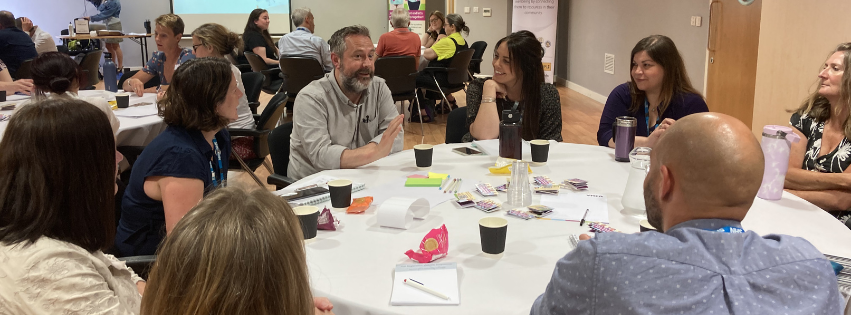
We delivered the training online via Zoom. This helped bring the project into budget and also made it accessible to people with caring responsibilities and other disabilities who might not be able to travel to an in-person session. Through our Zoom room we managed to have some very in-depth discussions and I was particularly struck by how thoughtful and considerate the group were around the ethical issues of Community Reporting, something that we cover in our Safe and Responsible Practice element of our training.
“I thought people that were attending were getting a lot out of it, because they were asking a lot of questions, they seem really actively involved.” Project Manager for ARF, Gaddum
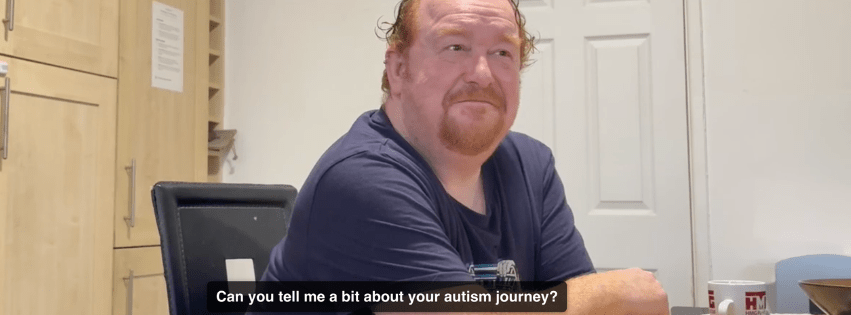
As homework, one Community Reporter collected a story about a person’s journey to autism diagnosis. We used this story to practice our story curation skills and had a great discussion about it, identifying key themes like the importance of support, the importance of education, the intersection between neurodivergence and mental health, and the usefulness of diagnosis as a way to understand the self and the past.
“It’s very rarely done in this way, it… nobody else does it in this way. I’m sure there are other Community Reporters in Manchester, but not in the way that we’ve done it, combined into our things around system change.” Coproduction and Engagement Service Manager, Gaddum
After completing the evidence-gathering for the ARF project, Gaddum are now looking at places to employ their Community Reporters and their skills in other areas of the organisation, such as their recent Manchester Living Well project. Although attendance and retention issues meant that fewer people completed the training than anticipated, Gaddum are still glad to have a small pool of people with these new skills, who are now going on to get more involved with other opportunities within the organisation.
“We always want to upskill and build the confidence of people, and that was just a brilliant way to do it.” Lived Experience Worker, Gaddum
If your organisation would like to use Community Reporting, a rigorous and responsible methodological framework for peer-to-peer lived experience storytelling, we can put together a bespoke training package to meet your needs and budget. Please get in touch with us at enquiries@peoplesvoicemedia.co.uk to have a chat.
One of our recent successes has been our work in close conjunction with Lincolnshire Voluntary Engagement Team (LVET). LVET had a strong vision for how they wanted to use Community Reporting to enhance the role of lived experience within service development across Lincolnshire’s Health and Wellbeing sector, and it has been a really joyous experience to support them on their journey. We think the work carried out here is a great example of how place-based Community Reporting projects can be structured and rolled out to ensure sustainability and spread. Read on to find out more…
The Community Reporting Applied Learning Project is a collaboration between People’s Voice Media and Lincolnshire Voluntary Engagement Team (LVET). LVET brings together voluntary, community, faith-based, and social enterprise (VCFSE) organisations across Lincolnshire – each committed to health, care, or wellbeing. Staff and volunteers were trained to use Community Reporting as a tool for gathering lived experience stories, to identify key insights, and use these to shape local services.
I think other people’s stories are invaluable and important because when we can hear someone’s story, understand someone’s story, then actually that’s when we begin to have empathy.
This quote shows the sentiment that lies at the heart of the Lincolnshire Community Reporting Applied Learning Project. The aim is to transform how health, care, and wellbeing services connect with local people.
Since its launch in February 2025, the project has created a foundation for empathy-driven improvement by prioritising local people’s lived experiences of health and care services in the area. Lincolnshire is England’s second largest county, after Yorkshire. Its landscape stretches from the fenland by the Wash on the North Sea coast to the Humber Estuary, which creates unique geographical and demographic diversity. These differences bring distinct health challenges. In coastal regions, overlapping issues such as ageing populations, isolation, and deprivation lead to lower life expectancy and higher disease rates. As the project continues, the hope is the approach of Community Reporting will help bridge gaps in health and wellbeing, ensuring that every community’s needs are understood and addressed.
Project aim and approach
The primary aim of the project was to build the capacity of Lincolnshire’s health, care, and wellbeing workforce to use Community Reporting as a sustainable method of lived experience research.
Gathering people’s experiences of local health and social care services, the project seeks to pick out key insights from the stories that can influence how services are designed. These learnings are then used to catalyse positive change through improvements in local services and relationships.
What we did
The project was rolled out in 3 phases.
Phase 1 (February 2025) – Community Reporting training: Staff and volunteers from local organisations in the health, wellbeing and voluntary sectors undertook training in story gathering and safe and responsible practice.
Phase 2 (April 2025) Community Reporting training: After a break to allow them to gather lived experience stories, the group came back together to review and curate the stories and make sense of the findings.
Conversation of Change Event (June 2025): the group held an event to mobilise the stories – showcasing the stories to local changemakers and leaders and making actions for change
Phase 3 (September 2025) Train the Trainer Training: Community Reporters then received training in how to deliver the Community Reporter training themselves. This means that the Community Reporting skills can now be spread further through the county’s VCFSE organisations and the LVET network.
Since this, Lincolnshire Community Reporter trainers have hosted two Community Reporter training programmes, bringing more people into the project to gather stories and feed into the insights being gathered about health and wellbeing in the county.
This model has ensured the longevity of the project, with the train-the-trainer sessions acting as capacity building exercises. The trained Community Reporters have now established a Community of Practice and means that Community Reporting can be used sustainably across the county in the voluntary sector and within the health, care, and wellbeing workforce.
Key outcomes of the project
Lincolnshire health, care, and wellbeing workforce have developed the skills and knowledge to effectively work with lived experience storytelling within relevant service settings
An ‘insight engine’ has been developed by using the Community Reporter Network website. The Our Shared Stories insight engine captures the lived experiences of residents on issues relevant to health, care, and wellbeing in Lincolnshire, and provides a research resource for local organisations and communities to use to enhance service provision.
Through the stories collected, voices of residents on topics pertinent to health, care, and wellbeing have been platformed to catalyse meaningful, real-world change in Lincolnshire as part of an ongoing co-production dialogue connected to ‘Our Shared Agreement’.
Community Reporting in Lincolnshire is not just a method—it’s a movement towards fairer, more responsive services across Lincolnshire.
If you’d like to explore how to embed lived experience and use its insights to improve service design, development and delivery in your area, please get in touch: enquiries@peoplesvoicemedia.co.uk
Future Changemakers is a three-year project, funded by BBC Children in Need, where People’s Voice Media are working with youth organisations across the country to build a Young Community Reporters Network. Each youth organisation is receiving training in the Community Reporter method, giving young people the skills and knowledge to get their voices and their lived experience stories heard to create change. We will also be working with youth leaders to undertake “train-the-trainer” work, so that they can embed youth voice within their groups for the future. Here, facilitator and project manager Lauren Wallace-Thompson gives us an update on the first youth group to take part in the programme:
I had the pleasure of working with the wonderful Army of Kindness in Rochdale, training some of the young people in Community Reporting methods to support their changemaking work. They are no strangers to social action, running weekly soup kitchens and supporting people in their community on a regular basis. A brilliant example of how people can come together in positive action!
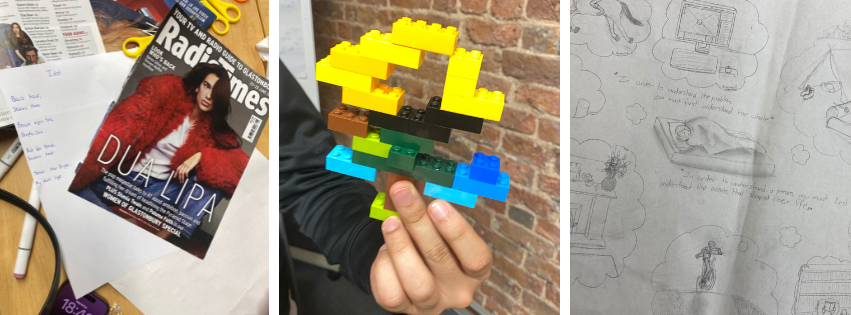
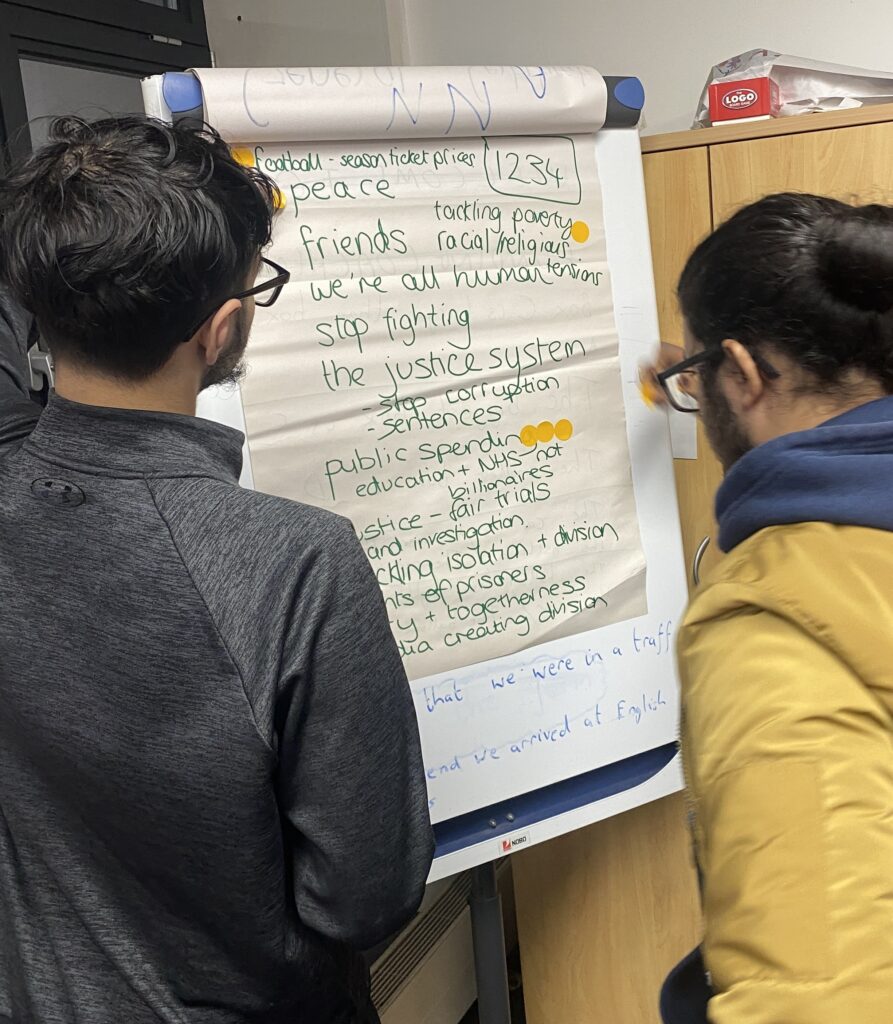
I visited the group for evening creative workshop sessions where we looked at why stories are so important in our lives, and explored telling our own stories and what was important to us through Lego, collage, poetry and models. The young people produced sculptures dealing with bereavement, justice, and belonging; poetry about Dua Lipa and what it is to be misunderstood by your parents; and some incredible drawings by talented young artists telling memories of family trips to Umrah, and their hopes for their future. Some of the young people also shared their lived experiences of racism and prejudice, and this became a key focus for the group’s work and their social actions.
One of the things I enjoy most about my job is how I learn new things all the time from the people taking part in our projects. Every session is like a lesson from ten different teachers, all with their own specialist subjects. But the young people in Army of Kindness especially made an impact on me with their really insightful reflections on the influence of social media in their lives and the ways in which personal connections and understanding can bring people together. They also gave me an education in great snacking – grating cheese into a Pot Noodle was a culinary revelation – and I had, shockingly, never tried Irn Bru before (“Asian beer”, according to the group’s leader).
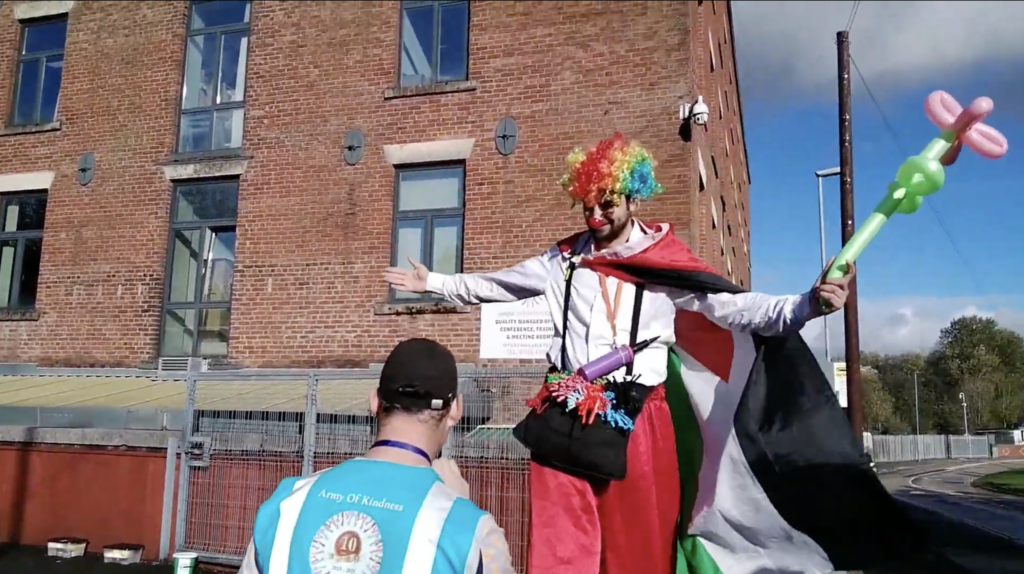
The group put the Community Reporting skills they had learnt into action when they held a community funday in the October half-term holidays, gathering video and audio stories from attendees at the funday to find out what they thought about the event. The Young Community Reporters interviewed a great range of people to get their experiences of the day, including a clown, a local councillor, and a 9-year-old entrepreneur!
The young people then learnt how to analyse the findings of our Community Reporting in a “sense-making” session. Here are the trends they identified:
The stories provided a sense of how people had enjoyed the event, but also praise for the wider work that Army of Kindness does locally.
People would like to see more events like this in the future.
Attendees especially enjoyed the food and community spirit.
People appreciated the opportunity to give towards a good cause
The diversity of attendees was a positive and the event gave people a chance to learn about each others’ cultures.
Reflecting on the stories as a whole, the group saw how it was a way to get detailed, experiential feedback to evaluate their event, but also noted how Community Reporting could be a tool to gather information to support their group and their work going forwards, such as comments about the positive differences that Army of Kindness have made to the local community, which might support their fundraising, grant applications and profile-raising.
Here are some perspectives from the young people taking part in the Future Changemakers project:
“I learned about dialogue interviews, different types of questions, and how to be more professional in interviews.”
“I really enjoyed getting to know and hear about the perspectives of other people.”
“The session was awesome, I really enjoyed it, especially the practical interviewing part.”
“I learnt that everyone has their own stories.”
“Everyone is human we need to stay in peace.”
“I learned new information about life in Rochdale for religious women.”
People’s Voice Media will return to Rochdale this spring/summer to train youth leaders and older young people in a “train the Trainer” session, so that they can deliver Community Reporter training to more young people and keep the skills of Community Reporting and extend their use within Army of Kindness.
We are still in the first year of the project. Our second group are Police Cadets in the West Midlands – stay tuned for updates on how they got on.
If you are running a youth group or other youth project and would be interested in learning a tool to increase youth voice and participation, and build communication and media skills among the young people you support, there are still some spaces left to join the project in Year 2 and 3. Please email lauren@peoplesvoicemedia.co.uk for more information.
We use cookies on our website to give you the most relevant experience by remembering your preferences and repeat visits. By clicking “Accept”, you consent to the use of ALL the cookies. More Info
This website uses cookies to improve your experience while you navigate through the website. Out of these, the cookies that are categorized as necessary are stored on your browser as they are essential for the working of basic functionalities of the website. We also use third-party cookies that help us analyze and understand how you use this website. These cookies will be stored in your browser only with your consent. You also have the option to opt-out of these cookies. But opting out of some of these cookies may affect your browsing experience.
Necessary cookies are absolutely essential for the website to function properly. This category only includes cookies that ensures basic functionalities and security features of the website. These cookies do not store any personal information.
Any cookies that may not be particularly necessary for the website to function and is used specifically to collect user personal data via analytics, ads, other embedded contents are termed as non-necessary cookies. It is mandatory to procure user consent prior to running these cookies on your website.