Tag Conversation of Change

LISTENING FOR CHANGE: ACCOUNTABILITY IN ADULT SOCIAL CARE
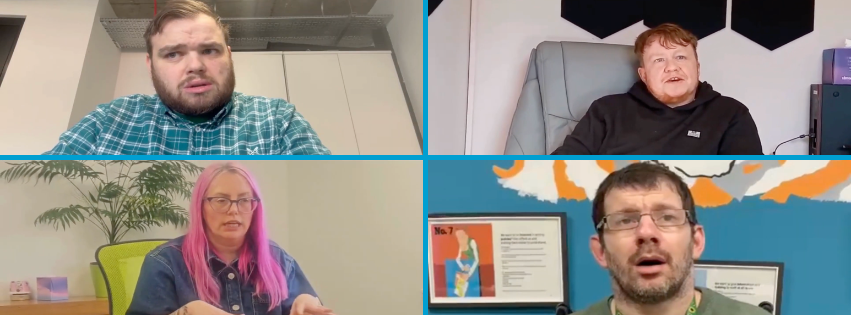
An image grid showing screenshots from four videos where people with learning disabilities and carers are sharing their lived experience to camera in Community Reporting interviews. The people are a white man in a beard and a checked shirt, a person wearing a black hoodie, a woman with bright pink hair and a man with facial hair, glasses and a sunflower lanyard.

Thera Scotland and People’s Voice Media are using lived-experience stories to open conversations about accountability, advocacy and better support in adult social care. In this blog, project manager and Head of Team and Operations, Kath Peters, tells us more.

What does accountability in adult social care look like when it is shaped by the people who experience services first-hand?

Since January, People’s Voice Media has been working with Thera Scotland to explore this question through lived-experience storytelling; gathering people’s views on what transparent accountability means in practice.

Thera Scotland supports people with a learning disability across Scotland, helping them have more control over their support and live their lives as they choose. Funded by IMPACT, the UK centre for implementing evidence in adult social care, our project forms part of a wider effort to bring research, lived experience and practice-based knowledge together to improve frontline services.

A key aim for the work is to create space for Disabled people, caregivers and supporters to share their stories, reflect on why accountability matters, and identify how adult social care could work better for the people who rely on it.

Training Community Reporters

The project began in February with online training sessions. Participants were introduced to Community Reporting techniques and supported to start meaningful conversations with others about their experiences of adult social care. The training helped people feel more confident to listen carefully, ask open questions and capture stories in a respectful way.

Members, volunteers and caregivers then spoke with friends and family about how the lack of accountability and inefficient complaints procedures affects people’s lives and what better systems could look like. These insights were brought together in a short video, which became the starting point for a Conversation of Change event on 29 June 2026.

From awareness to improvement

A Conversation of Change event is a tool that we use to progress a project from the stage of collecting stories, to using those stories to create change. At a Conversation of Change event, excerpts from stories sharing people’s lived and living experience are used as a catalyst for discussion, reflection and practical improvement. Lived experience is placed at the centre of the conversation, rather than seen as an add-on to professional knowledge. Service providers, supporters and members of the wider community are invited to actively participate in the event, learning from the stories and thinking about concrete actions towards change.

Through the video stories, Disabled people and carers were able to express what transparent accountability means in everyday life. Topics explored included:

  • how decisions are explained
  • how concerns are responded to
  • how people can challenge poor practice without feeling ignored or powerless

Overall, the stories demonstrated that when support works well, people are more able to make choices, build confidence and live with greater independence. When it falls short, the impact can be felt not only by the person receiving support, but also by families, caregivers and wider support networks. This showed how practical issues intersect with people’s personal and interior lives.

Conversation of Change events act as a bridge between awareness and action. By hearing directly from people with lived experience, those involved in shaping and delivering services are encouraged to think beyond broad commitments and consider what accountability looks like in day-to-day practice. That might mean clearer communication, more consistent follow-up when concerns are raised, stronger advocacy routes, or better ways of involving people in decisions about their own support.

Actions for change

IMPACT will now use the video as a conversation starter at targeted events, to help partners move from reflection to practical action. These events will invite people to look closely at what has been shared, identify the actions that matter most, and consider how to make tangible change. Raising awareness of the issues is the first step, but the events create a clear route from lived-experience insight to demonstrable change in adult social care.

By continuing to share and discuss these stories, the project keeps attention focused on the people most affected by adult social care. Community Reporting and lived experience storytelling are used to open dialogue, challenge assumptions and support more accountable, person-centred ways of working. As the work develops, the conversations begun through Thera Scotland, People’s Voice Media and IMPACT’s partnership will help shape practical actions that are informed by the realities of people’s lives.
INSIGHT ENGINES AND EMPATHY: COMMUNITY REPORTING IN LINCOLNSHIRE’S HEALTH AND WELLBEING SECTOR

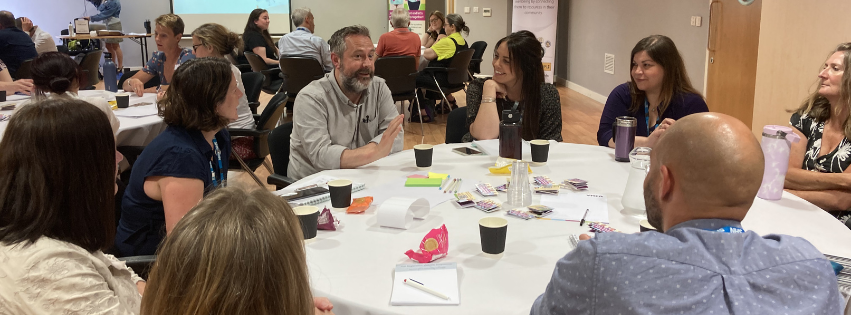
People sit around large tables in a brightly lit, modern conference room, having an animated discussion.

One of our recent successes has been our work in close conjunction with Lincolnshire Voluntary Engagement Team (LVET). LVET had a strong vision for how they wanted to use Community Reporting to enhance the role of lived experience within service development across Lincolnshire’s Health and Wellbeing sector, and it has been a really joyous experience to support them on their journey. We think the work carried out here is a great example of how place-based Community Reporting projects can be structured and rolled out to ensure sustainability and spread. Read on to find out more…

The Community Reporting Applied Learning Project is a collaboration between People’s Voice Media and Lincolnshire Voluntary Engagement Team (LVET). LVET brings together voluntary, community, faith-based, and social enterprise (VCFSE) organisations across Lincolnshire – each committed to health, care, or wellbeing. Staff and volunteers were trained to use Community Reporting as a tool for gathering lived experience stories, to identify key insights, and use these to shape local services.

I think other people’s stories are invaluable and important because when we can hear someone’s story, understand someone’s story, then actually that’s when we begin to have empathy.

This quote shows the sentiment that lies at the heart of the Lincolnshire Community Reporting Applied Learning Project. The aim is to transform how health, care, and wellbeing services connect with local people.

Since its launch in February 2025, the project has created a foundation for empathy-driven improvement by prioritising local people’s lived experiences of health and care services in the area. Lincolnshire is England’s second largest county, after Yorkshire. Its landscape stretches from the fenland by the Wash on the North Sea coast to the Humber Estuary, which creates unique geographical and demographic diversity. These differences bring distinct health challenges. In coastal regions, overlapping issues such as ageing populations, isolation, and deprivation lead to lower life expectancy and higher disease rates. As the project continues, the hope is the approach of Community Reporting will help bridge gaps in health and wellbeing, ensuring that every community’s needs are understood and addressed.

Project aim and approach

The primary aim of the project was to build the capacity of Lincolnshire’s health, care, and wellbeing workforce to use Community Reporting as a sustainable method of lived experience research. 

Gathering people’s experiences of local health and social care services, the project seeks to pick out key insights from the stories that can influence how services are designed. These learnings are then used to catalyse positive change through improvements in local services and relationships.

What we did

The project was rolled out in 3 phases. 

  • Phase 1 (February 2025) – Community Reporting training: Staff and volunteers from local organisations in the health, wellbeing and voluntary sectors undertook training in story gathering and safe and responsible practice.
  • Phase 2 (April 2025) Community Reporting training: After a break to allow them to gather lived experience stories, the group came back together to review and curate the stories and make sense of the findings.
    • Conversation of Change Event (June 2025): the group held an event to mobilise the stories – showcasing the stories to local changemakers and leaders and making actions for change
  • Phase 3 (September 2025) Train the Trainer Training: Community Reporters then received training in how to deliver the Community Reporter training themselves. This means that the Community Reporting skills can now be spread further through the county’s VCFSE organisations and the LVET network.
    • Since this, Lincolnshire Community Reporter trainers have hosted two Community Reporter training programmes, bringing more people into the project to gather stories and feed into the insights being gathered about health and wellbeing in the county.

This model has ensured the longevity of the project, with the train-the-trainer sessions acting as capacity building exercises. The trained Community Reporters have now established a Community of Practice and means that Community Reporting can be used sustainably across the county in the voluntary sector and within the health, care, and wellbeing workforce.

Key outcomes of the project

  • Lincolnshire health, care, and wellbeing workforce have developed the skills and knowledge to effectively work with lived experience storytelling within relevant service settings
  • An ‘insight engine’ has been developed by using the Community Reporter Network website. The Our Shared Stories insight engine captures the lived experiences of residents on issues relevant to health, care, and wellbeing in Lincolnshire, and provides a research resource for local organisations and communities to use to enhance service provision.
  • Through the stories collected, voices of residents on topics pertinent to health, care, and wellbeing have been platformed to catalyse meaningful, real-world change in Lincolnshire as part of an ongoing co-production dialogue connected to ‘Our Shared Agreement’.

Community Reporting in Lincolnshire is not just a method—it’s a movement towards fairer, more responsive services across Lincolnshire.

You can hear more about the project on this It’s All About People podcast that LVET produced after their Conversation of Change event: https://www.itsallaboutpeople.info/our-work/community-reporting

If you’d like to explore how to embed lived experience and use its insights to improve service design, development and delivery in your area, please get in touch: enquiries@peoplesvoicemedia.co.uk