Ripple Effect Mapping is a hugely useful and flexible evaluation tool for those working in communities and change-making, dealing with trying to make change on social issues where benefits aren’t always immediate, obvious or tangible. As part of our recent work with Bristol City Council on the evaluation of their Community Resilience Fund, People’s Voice Media led four Ripple Effect Mapping sessions with people representing community organisations that had received grant funding for capital projects. In this blog, Lauren Wallace-Thompson, our Communications and Community Engagement Manager, gives our top 6 reasons that we love to employ this tool to support partners, communities and clients with evaluation and learning.
Does it seem a little OTT to have a favourite evaluation tool? I’ve been a researcher for over 15 years now, and to be honest, the word “methodologies” still kind of brings me out in a cold sweat. At People’s Voice Media, we spend a lot of time bigging up the importance of “qualitative” data (that is, data other than pure numbers – which could be words, feelings, pictures, videos). We collect lots of stories from individuals via our Community Reporting method, and use these to create datasets of people’s experiences in their own words. Sometimes however, we want to “zoom out” slightly, and look at the bigger picture. Where we are trying to create change in a community, a system, an organisation or on a social issue, we need a way to capture all the various ways in which an intervention has an impact.
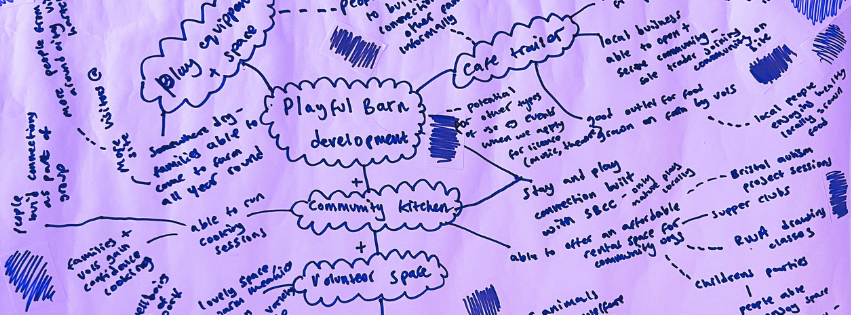
Enter, stage right, waving a flipchart marker pen: Ripple Effect Mapping. It’s a people-powered, flexible tool for discovering what has changed. It has lots of great features, and you can find out a bit more about how the process works on our previous blog. It involves getting people together in a room with a giant sheet of paper and some marker pens, and really thinking through all the changes that have happened. In the case of the Bristol City Council work, the “intervention” was funding for capital improvements awarded to 56 community organisations or projects. But it could be anything – the results of a campaign, a change in policy, a training programme, a social action, a charitable act.
Here are 6 things that we love about using Ripple Effect Mapping for evaluation:
1. It’s collaborative
Ripple Effect Mapping is always most powerful when undertaken in groups to make the most of the “hive mind”, and to gather perspectives from different parts of an organisation. You can bring in views and ideas from senior management, volunteers, beneficiaries, trustees, project coordinators, local residents and more. Different people will have experienced the changes in different ways, and observed things others haven’t. It really makes the most of collective knowledge.
2. It gives over power to the people who understand best
Ripple Effect Mapping hands over the identification of impact to the people with the real expertise. Can an external evaluator judge exactly what changes have occurred? Can they notice subtle and unintended consequences (especially that go beyond those stated on the initial project brief, for example)? Well, maybe. But probably not as much as someone who has been embedded in the organisation, or lives in the community, and has witnessed the change first-hand.
3. It’s flexible
Sometimes evaluation markers can be set from the outset of a project – and they remain fixed. Which means that other things that change might be overlooked.
Ripple Effect Mapping starts with a blank sheet of paper, which means there’s no parameters on what can be recorded and tracked.
For this reason, we always say that it’s good for tracking:
- both postive and negative outcomes
- expected and unexpected consequences
- intentional and unintended results
- direct impacts, and others that are more tangential
- changes that have already occurred, and things that are now in progress for the future
4. It’s genuinely joyful
Of all the different sessions I deliver when facilitating with People’s Voice Media, it’s Ripple Effect Mapping sessions that I look forward to the most. For lots of organisations or community groups, it’s the first time they’ve ever stepped back and put down all their achievements and successes down on paper, and they are often both surprised and proud (rightly so!) at the impact of their work. We do always make sure as facilitators that the group spends some time considering any downsides, challenges or misfires that have occurred, but overwhelmingly these sessions are full of positivity and celebration.
5. It tells a story
A key part of our Ripple Effect Mapping sessions is where we ask participants to talk us through their maps. This really gives people the chance to process all that they’ve discovered into a narrative that shows a journey of change, improvement and learning. This in itself can be a really powerful moment for a community or organisation, where they recognise their own capacity to create change. And you know how fond of a story we are here at People’s Voice Media!
6. It can be longitudinal
Or perhaps we should make that, it should be longitudinal. With many projects, interventions or changes, it can take a long time to see the full picture of the real world impacts that are created. The old “Rome wasn’t built in a day” cliche holds especially true when you’re dealing with complex social issues or within rigid systems where change can be slow.
Ripple Effect Mapping is really useful for tracking change over time, and supporting continuous learning and improvement. We often recommend that groups repeat the Ripple Effect Mapping process at intervals both during and after a project (say every six or 12 months), or after key milestones are achieved. A snapshot immediately after a project finishes might not give enough time for the impact “ripples” to have worked through and spread out, so try doing a Ripple Effect Map again 6 months down the line, and compare the two to get a fuller picture of those longer-term impacts and changes.
“This approach to evaluation was an exciting venture for us. It has allowed us to be creative and highlight the real life impacts of our work – we often get stuck behind figures, so it’s been fantastic to bring the fund’s impacts to life. We’re already, as a team, using the REM tool in other areas of work, so this project has given us all some professional skills!” – Bristol City Council Community Development Team
And one thing we don’t love so much…
It’s messy. Oh, it’s messy. Getting the sprawling thoughts of a group of people down on paper in a limited amount of time can mean that some of those maps look like a toddler has been let loose with the felt tips. That’s okay, though – it’s all part of the process and we’re here to help hold you in the chaos. That’s why it is really helpful to have someone external to come in and facilitate the process, adding in some structure and ensuring there is time for interpretation and explanation, and then working to extract and analyse the data from the maps into useful learning and action.
If you would like People’s Voice Media to design and facilitate a Ripple Effect Mapping process to support your organisation with its learning and evaluation, please get in touch. Just email enquiries@peoplesvoicemedia.co.uk or leave us a comment below!