STORIES FOR CHANGE: A WEEK OF CONVERSATION AND LEARNING
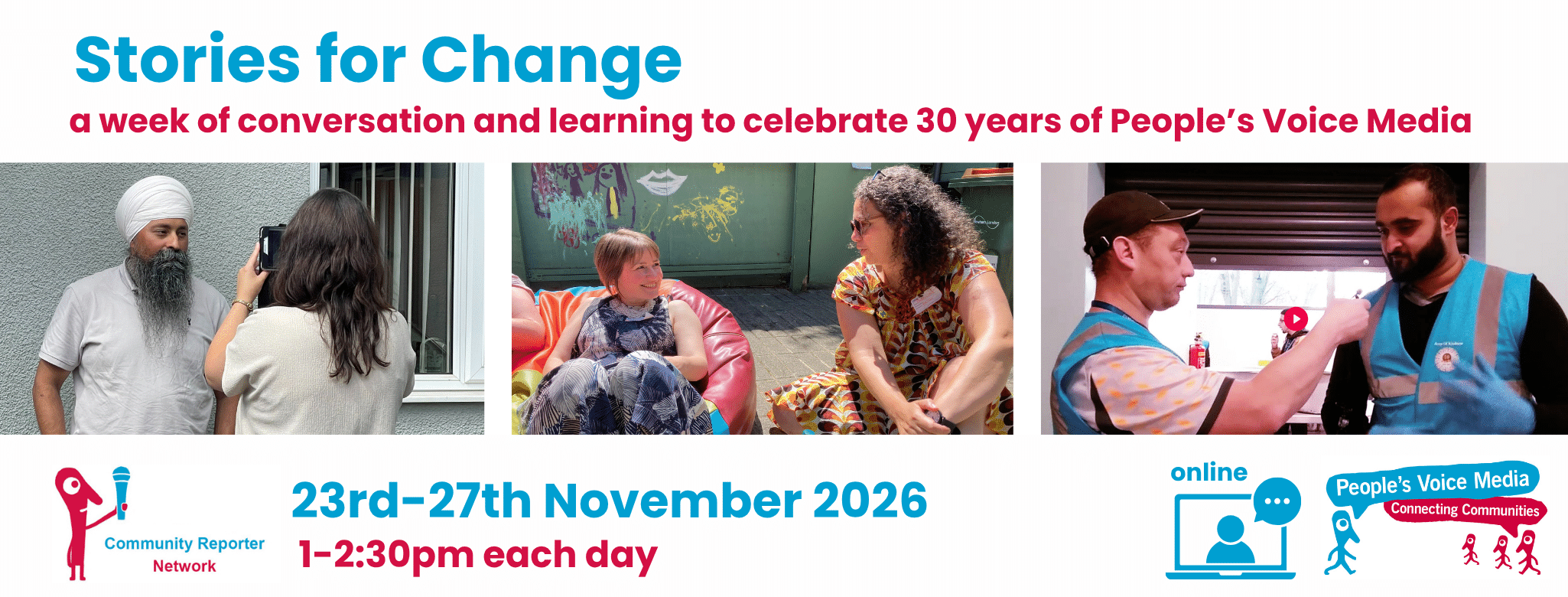
This year, People’s Voice Media turns 30. That means that for 30 years, we have worked alongside communities to create spaces where people can tell their own stories, share knowledge, and influence change. To celebrate our birthday, we are calling people together for a week of conversation, learning and community – Stories for Change. Find out more below or book your sessions now.
We’re getting rid of conference lanyards and dry sandwich buffets this year – this is a conference you can join from the comfort of your sofa. All sessions will take place on Zoom, and will be interactive, conversational spaces with a focus on building knowledge and practice as a community of people who care about lived experience storytelling.
What will the conversations be about?
We’ve spent a lot of time over the past 30 years championing the value of lived experience stories and trying to get people in power to recognize the expertise held by people who have first-hand knowledge to share. It does feel like the rest of the world is finally catching on. However, at the same time, the culture in which stories are created and heard has transformed. Speaking about your lived experience now means engaging with a structure of digital platforms owned and controlled by billionaires, algorithmic gatekeeping, AI deepfakes, a media landscape hostile to issues of social justice, and shifting questions about who gets to speak and be believed. We are now in an age where anyone can publish their story online, yet whose voice gets heard, believed, and acted on still depends on old and unequal rules. Technology has given communities new ways of organising and connecting, but inequalities around access, power, representation, and whose stories are trusted, remain. The Zoom conversations we have across the week will centre around this question:
Who holds the power around these stories, and how do we make sure they are seen as real evidence, knowledge, and insight?
How will the week work?
We will be hosting five guided sessions across the week, taking place on Zoom from 1pm – 2:30pm each weekday. Each day builds on the learning and questions from the previous one, but all sessions will make sense as standalone events, so you can attend as many or as few as you like.
Here’s the schedule for the week:
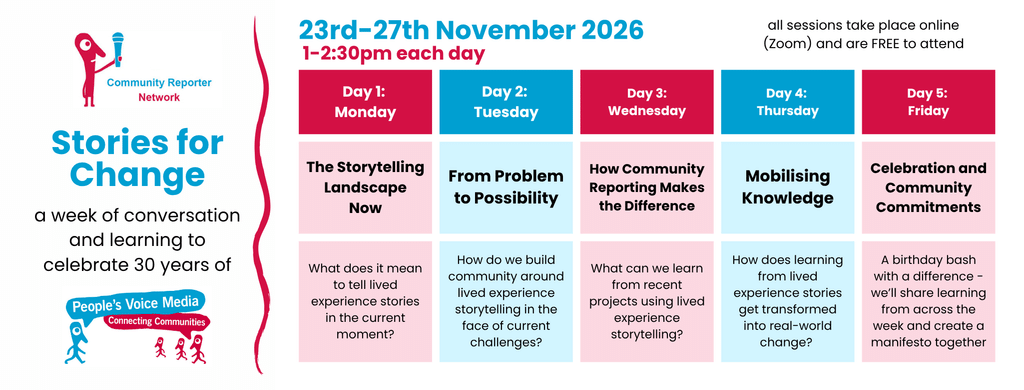
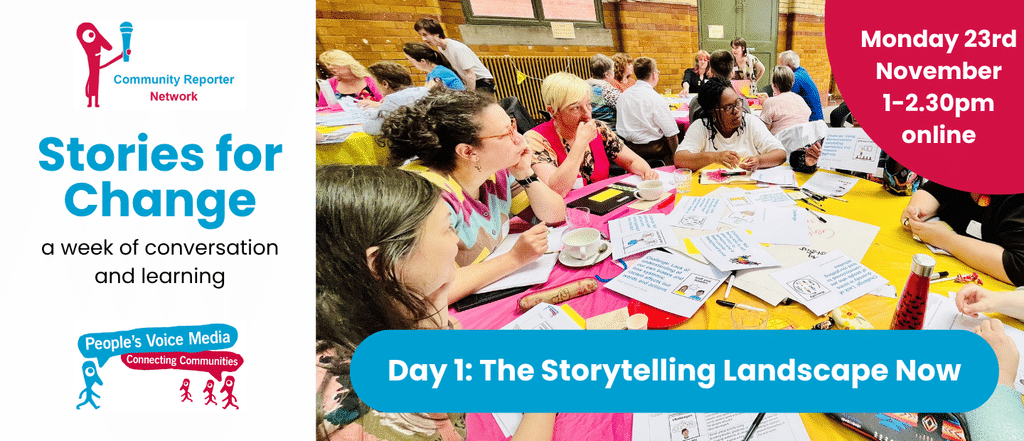
Day 1: Monday – The Storytelling Landscape Now, 1-2:30pm
What does it mean to tell lived experience stories in the current moment? Join us for the opening provocation of our week of conversation and learning. In this 90 minute online session, we will confront the storytelling landscape as it actually is: digital access and exclusion, the rise of fake news, disinformation, AI-generated content and a public conversation pulled apart by polarisation. To set the scene for our learning this week, we name the conditions everyone telling a story now has to work within.
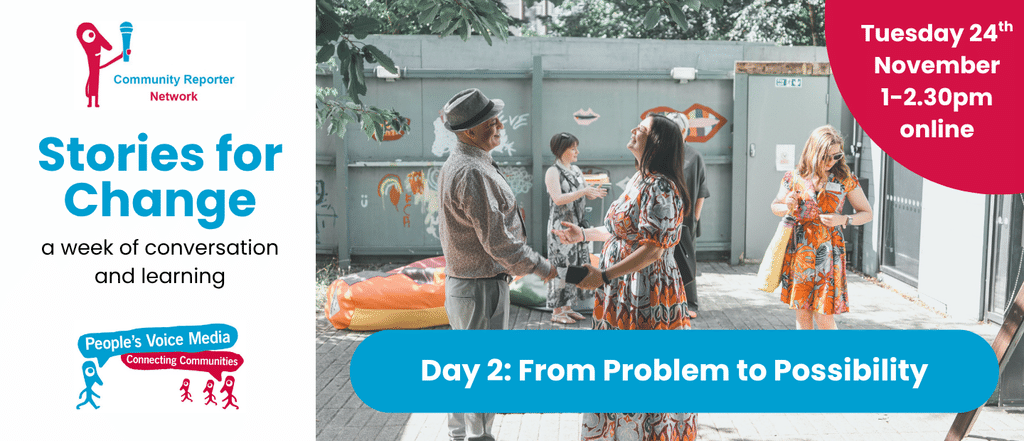
Day 2: Tuesday – From Problem to Possibility (A Calling-In), 1-2:30pm
How do we build community around lived experience storytelling in the face of current challenges? This is a 90-minute online reflective practice session about our collective role as guardians of stories. Where Day 1 names the problem, Day 2 turns towards the solutions. This is a calling-in space for building a movement that protects and champions lived experience storytelling, and for asking what the community needs to do to advance storytelling in the face of everything named the day before.
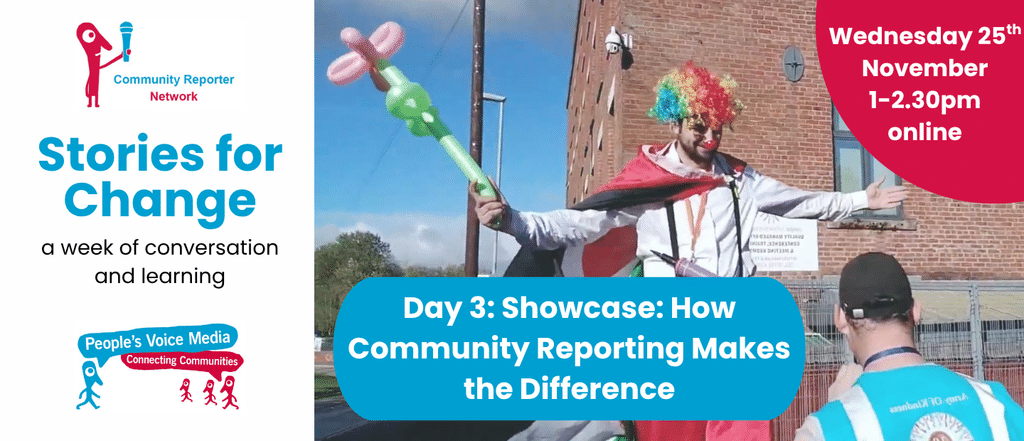
Day 3: Wednesday – Showcase: How Community Reporting Makes the Difference, 1-2:30pm
What can we learn from recent projects employing lived experience storytelling? A showcase of real examples of how People’s Voice Media and partners’ work happens. In this session we’ll explore the difference Community Reporting can make through three case studies of lived experience storytelling in practice.
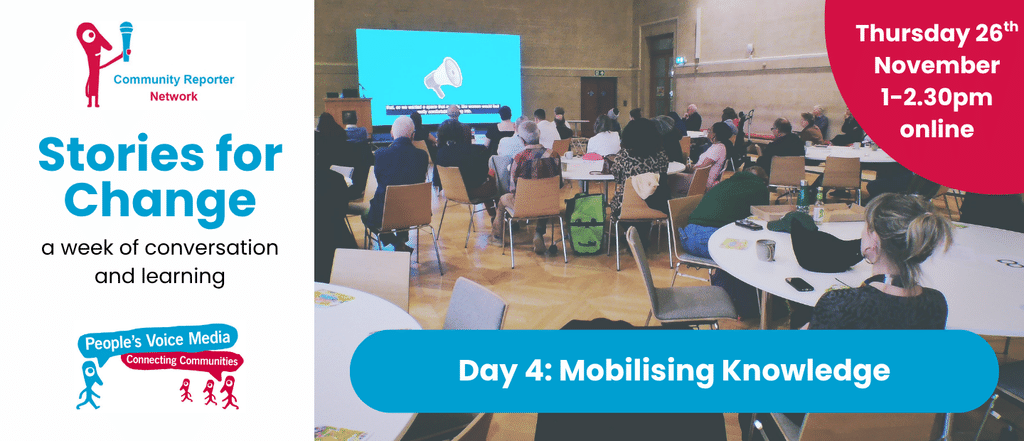
Day 4: Thursday – Mobilising Knowledge, 1-2:30pm
How does learning from lived experience stories get transformed into real-world change? This session explores what happens once the data is gathered – how does community knowledge connect to research, policy, commissioning, services and campaigning – and what are the blockers to success in this area?
Day 5: Friday – Celebration and Community Commitments, 1-2:30pm
A birthday bash with a difference. We’d love you to join us at the end of our week of learning and conversation in a special Friday session to celebrate 30 years of People’s Voice Media. This is a collection of human stories – voices from People’s Voice Media’s history, Community Reporters, partners and the grassroots. We will also share insights and findings from the Gobby Community Reporter survey and what we’ve learnt across the week. We will close by agreeing commitments that the community will carry forward together.
Frequently Asked Questions
Do I have to attend every session? No, just book on to the ones you are interested in or able to attend. Although the sessions are designed to “speak” to each other across the week, the content, learning and discussions should also stand alone.
Can I attend all the sessions? Yes, absolutely, we’d love to have you join us for the full week. Just make sure you register for each session separately.
How do I book? You can choose your sessions and book via the events page on the Community Reporter website.
Do I have to pay to sign up? No, all sessions are completely free to attend.
I have access needs, how will you make it so I can join in the sessions? Drop us an email enquries@peoplesvoicemedia.co.uk and let us know how we can make it easier for you to participate in the session. You don’t need to have a diagnosed disability to do this – just an idea of what we can do to support you or an access problem that we can try to solve. We will also send out a communication nearer the event to ask people about specific adaptations.
Can you cover personal assistant costs or other attendance costs? We have some budget put aside to support people who would otherwise not be able to join in the sessions – please get in touch with enquiries@peoplesvoicemedia.co.uk to discuss this.
Why is the conference online? We know that sometimes people who would like to attend our annual conference face barriers because of travel, accessibility, cost, caring responsibilities, geography and people’s different circumstances. Moving online for this year gives us a chance to experiment with a way of meeting up that removes some of those barriers. However, we know that online does not automatically mean accessible. Running an event digitally can also exclude some people or present difficulties, and we are trying to work with everyone attending to make sure we put in place as many things as we can to open up participation and adapt things to suit as many people’s needs as possible. If you have an idea for anything that would support towards this aim – please do let us know by emailing enquiries@peoplesvoicemedia.co.uk.
What will happen after the event? We don’t want these conversations to end there. We’ll be taking the learning into the year ahead, and using it to inform our planning, combined with the things we find out from the Gobby survey that is running alongside the event.
What topics will be discussed and how are you looking after people’s psychological safety?
Some of the conversations during the week will explore sensitive and personal issues around social justice, lived experience, power, and inequality. Where we think there are potential triggers, the facilitators will give notice about this before and during the session. All sessions will be run according to our anti-racist principles and guidelines for communication. We will share details of relevant support organisations during each session, and encourage people to participate in ways that feel right for them.
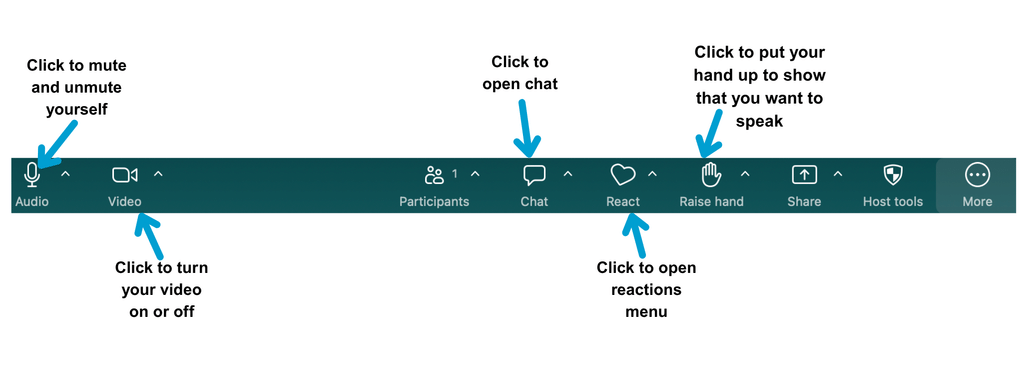
How can I contribute to the discussions? We want to make sure that everyone can contribute in a way that feels comfortable for them. This might be – through talking in a large group, contributing in a breakout room, writing your thoughts in the chat, using tools such as Flinga or Mentimeter. If we use any additional online tools, we’ll always do a demo first to show people how to use them, and if you’re struggling, please do ask the team for help!
Who will be facilitating the sessions? The sessions will be facilitated by members of the People’s Voice Media team, alongside co-producers from the Community Reporter Network. Some workshops will also have special guests from our projects or from other organisations connected to our work.
I have another question not covered here. If you’ve got a question – there’s a good chance other people have too! Please email us enquiries@peoplesvoicemedia.co.uk or leave a comment below and we’ll get you the answers, and update this guide too.