LGBT+ HISTORY MONTH: QUEER IDENTITIES AND STORYTELLING

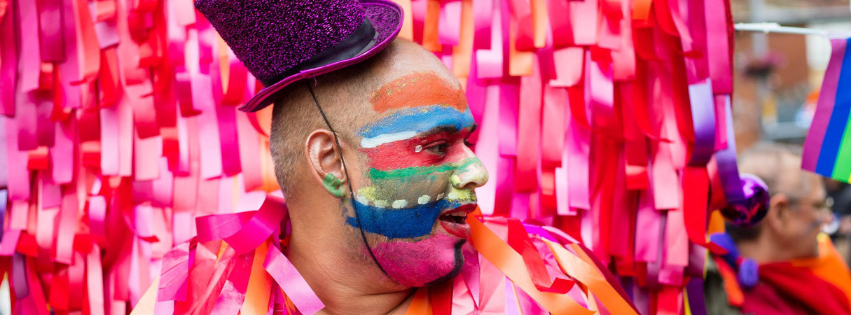
A close up of a man at a Pride parade, with a brightly-painted face and wearing a purple glittery top hat, against a background of pink

To celebrate LGTB+ History Month, our Head of Partnerships and Practice Isaac reflects on their experiences of storytelling and Community Reporting as a queer person.

Through storytelling, we work to stand up for social justice, build communities where everyone feels included, and give a voice to people who are often not heard or listened to.

For some considerable time, we’ve been working with stories: listening, learning, and sharing the experiences of real people. As a storyteller, my experiences don’t just come from the work I do. They come from who I am, especially as a queer person living in the world. LGBT+ History Month reminds us that our identities and experiences are part of our stories. They shape the questions we ask, the connections we make, and how we listen to others.

We’ve been learning and improving the way we capture people’s experiences. We work with Community Reporters, trainers, local people, policymakers, and others. Together, we collect stories, listen to real experiences, and bring them into conversations that matter. Each story helps us see the impact of our work and understand the change we need to make.

Recently, I had the chance to hear someone’s story about their transition. They described it as “turning from a caterpillar into a butterfly.” Listening to them really helped me understand, in a human way, what our brothers and sisters go through during this journey. It’s a story of courage, growth, and transformation.

This month is about celebrating LGBT+ History – the ways our similarities and differences make communities stronger. Being queer affects how I see storytelling, yes, but it also helps me make space for other experiences, notice voices that might not be heard, and share stories that build empathy, understanding, and real change.

Storytelling is like a mirror and a bridge. It shows who we are and connects us to each other. It helps us see how our differences can start conversations, how our shared humanity can build trust, and how every voice matters. The stories we tell, the spaces we create, the conversations we have are all acts of love and acts of justice.

For LGBT+ History Month, let’s remember that storytelling is more than a skill – it comes from lived experience. It’s about listening, putting people at the center, and creating spaces where everyone feels seen and heard. It’s about understanding people’s needs and helping make positive change happen.

We’re proud of the work we do and excited to keep learning, growing, and sharing stories that matter. At the heart of everything, it’s love – the love of community, of justice, and of giving everyone a voice.

THE BRONTE YOUTH & COMMUNITY CENTRE: INSIGHT REPORT LAUNCHED

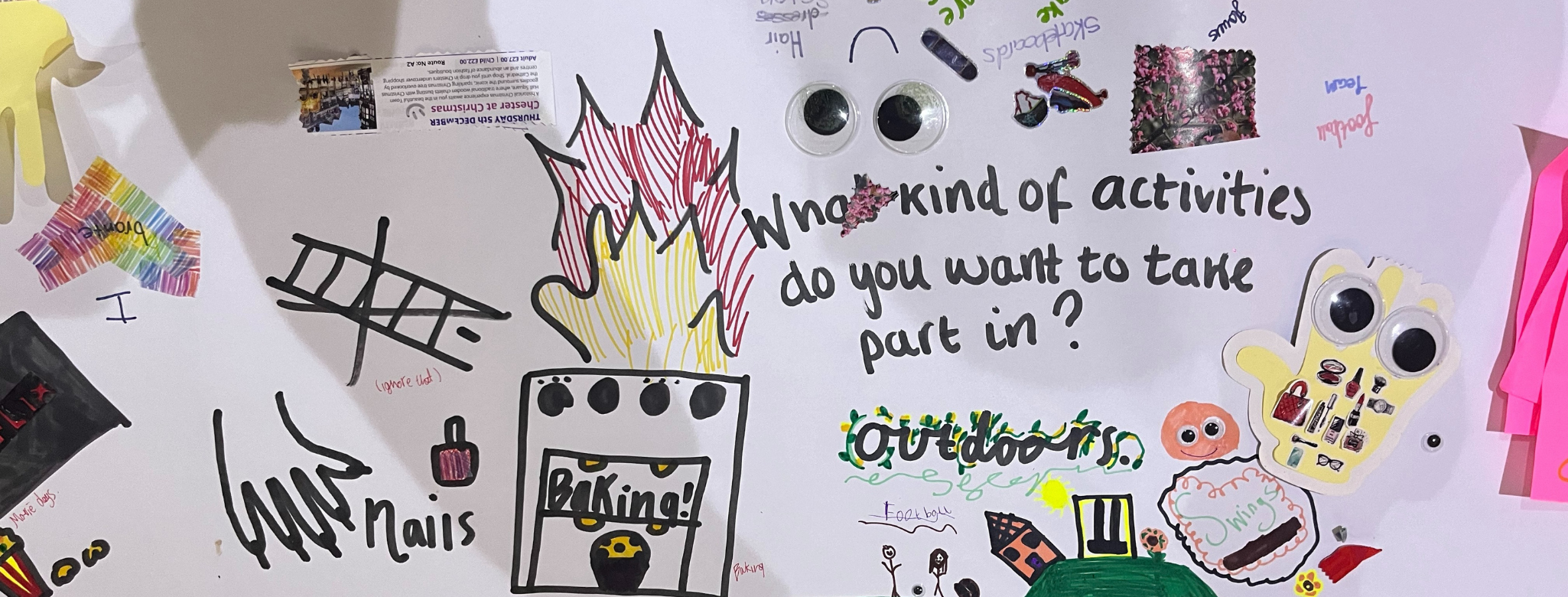
A collage of young peoples thoughts and ideas for the future of the bronte youth and community centre

Back in Summer of 2024, People’s Voice Media launched a project in Liverpool alongside The Bronte Youth & Community Centre. Young people came forward to share their stories and experiences with The Bronte, and contribute ideas for the future of the centre which is currently undergoing renovation work.

Since then, young people have developed skills in Community Reporting and have interviewed staff, peers and members of the community to gather their hopes for the future of the centre as well. These ideas will feed into the work that shapes the future of the building and help create a hub for the local community in Liverpool.

We have compiled the footage collected by the young people into a written insight report, which you can access via the link below. From young people’s vision for it’s the future, to it’s inter-generational impact & legacy, it’s clear that The Bronte has played a significant role in many people’s lives. Take a look and see what people had to say:

You can also view some of the stories recorded as part of the project over on the Community Reporter website here.

The future looks exciting for The Bronte, as young people and staff are currently working on a podcast series with Fact cinema in Liverpool, putting their Community Reporting skills into practice. Head over to the Bronte Youth and Community Centre website to hear more about their work & receive updates on the renovation plans.

The Voice of the Dragon – Being a Partner on the HOME? Heritage project

Dragons Voice CIC started working with People’s Voice Media (PVM) on the HOME? Project in May 2022 after discussions with Hayley (CEO of PVM). We feel privileged to be part of this project as we have worked with another organisation on a similar type of project. Initially we intended to gather stories from the BNO new arrivals from Hong Kong but this was not welcomed by that community as many feared for their safety and did not want to participate in a project that will showcase how they are living now since arriving in the UK.

We discussed this with PVM and Kath kindly agreed that we could look at alternative sectors of the Chinese community. In the end we recruited mainly from Mandarin speaker from mainland China who arrived in the UK within the last 10 years.

We found members of the PVM team to be very understanding and willing to adapt to our changing circumstances. As the director authorising the partnership agreement, I felt that PVM as an organisation stands true to its values. I have met Hayley a few times when I attended some training (early 2021) and at a conference way back in 2017. What came across was the philosophy of non-exploitation and letting people take control of their own stories.

How have the participants benefited from the project?

The participants who attended the Community Reporter training gained skills in doing short snapshot and dialogue interviews. They used a tablet to record the videos at the training sessions. The interviews were spoken in Chinese languages so they did not have to struggle with speaking in a second language. Some gathered stories after the training and uploaded them onto the Community Reporter website.

Those who attended the archive research training completed summaries of stories they found in the Manchester Evening newspaper. The focus was on finding stories on positive contributions from migrants. The skills they developed were firstly to locate the articles online and then sifting through the articles to find relevant stories. To conclude, they had to summarise and transfer core information onto the spreadsheet.

The training provided opportunities for strangers to meet up with other peers and transfer some of the learning into practice. Those who struggled with the archive research due to language were supported by those who had better English abilities. The project provided opportunities for participants to talk about and reflect on their migration journeys. Dragons Voice created 2 part-time posts for its volunteers, one to co-ordinate and the other to support in recruitment and organising activities.

Has Dragon’s Voice learned anything from taking part or from the stories?

There are many similarities in the stories, namely people migrate for better opportunities in life. There are always challenges to overcome in the initial transition, be it the weather in UK, availability of food they normally eat, language barriers or employment opportunities. The approach to interviewing in Community Reporting is very different to interviewing to mine for information, which is how we normally work when interviewing guests on our radio shows. In future we should be less focused on getting information we want and instead adopt a facilitative approach for the individuals we interview to tell their stories.

As a director I have learned to devise employment contracts for freelance workers but is not quite sure what to do when they pull out mid-way. I have had to step in and luckily as I had overall management of the project, I was able to pick it up without much trouble.

The Knowledge Exchange event puts the stories we gathered into a wider context and the roadmaps produced offers a sense of direction for future actions. It was good to meet up with other partners at the partners meetings, who worked across broader areas and are much more politically aware. Their comments provided different perspectives and food for thought.

At the conference in Liverpool, I found out about the other great projects that PVM is involved in and it opened my eyes to the broader work of community reporting.

I am painfully aware that Manchester has diverse migrant communities and it was with regret that we did not include these other groups in our project. We did offer the archive training to ALLFM presenter but there was no uptake advertising it on the volunteers steering group meetings and at ALLFM studio. We need to consider in future how to engage with other migrant groups within Manchester.

It is with much appreciation that Dragons Voice CIC was able to be a partner on this project. We hope to be able to work with People’s Voice Media again in the future.

Denise Yuen Megson

Director

Dragons Voice CIC

CO-PRODUCTION COLLECTIVE X PVM: ANTI RACISM PROJECT

This pilot project aims to strengthen our knowledge of people’s lived experience of racism and how this affects co-production.

PVM and the Co-Production Collective will be using lived experience to explore experiences of racism with co-production and identify ways in which structural racism can be addressed within the co-production arena.

Our objectives are to…

  • Ensure that diverse voices are present within our co-production communities
  • Understand how racism plays out within co-production
  • Understand what we can do to be an anti-racist co-production community & put this into practice
  • Gather 12 lived experience stories
  • Deliver sense-making sessions exploring these stories
  • Produce a short thematic film pulling out the key learning from the stories
  • Host a Learning Exchange event sharing these finding with the wider co-production community & beyond

As part of this project we’re aiming to bring about social change on an individual, organisational, community & societal level including…

Bringing individuals together to share their own lived experiences, knowledge and experiences of exclusion and inclusion around coproduction, lived experience and racism.
Strengthen the knowledge of the Co-Production Collective to be able to respond to the need of our community or the people our work tries to best serve that are from diverse backgrounds & catalyse action/generate ideas for making the co-production ‘space’ more diverse.
Create safe spaces to talk about systemic racism, coproduction, lived experience and the lack of diversity that the spaces can often show. Contribute to a wider mission to create social change for everybody to find a fair and just society where they have purpose and meaning regardless of any protected characteristics.

Over the next couple of months we’ll be collecting stories, delivering online sense making sessions and editing together a film based on the findings – all in preparation for the Learning Exchange event in January 2024.

Watch this space for more updates, including how to get involved!

CAMERADOS YEAR 2 LEARNING PARTNER WORK

Over the past 6 months, People’s Voice Media have been delivering a series of Ripple Effect Mapping Workshops and Storytelling Sessions with members of the Camerados Public Living Room movement.

Camerados is a social movement – which really just means that there are lots and lots of people (from Baltimore to Blackpool) who think being a bit more human is a good idea. The movement started in 2015 and the main thing you’ll see them doing is opening Public Living Rooms in different communities across the world.

What is a Public Living Room?

A public living room is an agenda free space for communities of people to come together, sit down with a cuppa, have a chat, and feel more human. It’s as simple as that!

So far there have been handful of online ripple effect mapping workshops and storytelling sessions. In these spaces representatives from different public living rooms have come together to reflect on what impact they’ve had in their local communities. Not only have they shared stories, but they’ve been busy producing Ripple Effect Maps.

What is Ripple Effect Mapping?

Ripple Effect Mapping is a technique that can be used by community organisations to measure and record the different levels of change that have happened as a result of their existence. Rather than focusing on numbers and statistics, REM helps to unpick and document the more qualitative ripples of impact that often occur in smaller scale community initiatives, but can be harder to monitor using quantitative means.

As part of the REM process, people mapped out the different forms of impact their public living rooms had led to. From boosting confidence in those who attended, to connecting people with wider community initiatives, there were endless ripples of impact. After noting these ideas down, people then began to categorize the impact based on individual, community and societal level change (hence the colourful dots you’ll see on the example maps above!) – this process helps people to visualize changes that otherwise would’ve been difficult to document. After the mapping process was complete each person reflected on their map by sharing their thoughts in the form of a story. By the end of the session we’d gained a deeper understanding of the intricacys of the PLRs and what impact they’d had on the communities they existed in.

Take a look at the photos above to get an idea of what a ripple effect map looks like!

From Rochdale, Greater Manchester to Boston, Massachussets, people have shared their experiences with setting up and running these spaces. We hope to share these experiences and findings more widely within the Camerados movement in the hopes of inspiring more public living rooms.

Keep your eyes peeled for updates on the finding of of this project!

You can find out more about the Camerados movement by visiting their website here.