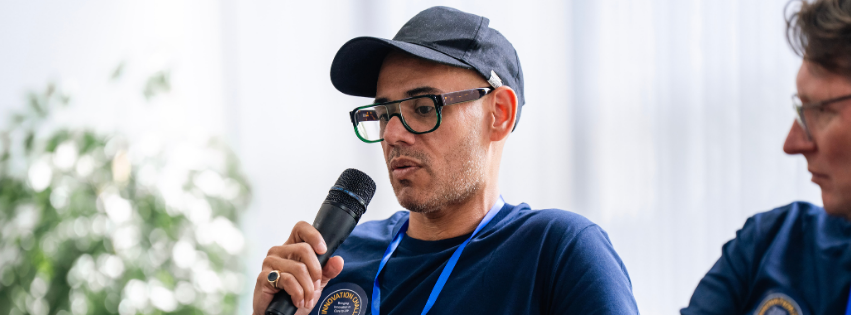
STORIES OF BLACK JOY: BLACK HISTORY MONTH
Black History Month is a time to recognise the contributions Black people have made, and continue to make, to the world. It also asks us to look at how history is told. Whose experiences are recorded? Whose knowledge is recognised? Who has the power to decide what future generations will learn? These questions connect directly to our work at People’s Voice Media. Lived experience storytelling creates opportunities for people to share what matters to them and use that knowledge to influence change. This October, we want to make space for Black joy, with Black people deciding for themselves what that means and what they want to share. As a kickstarter to this, one of our Community Reporters, Debora, had a chat with Aida, a story development specialist and audio producer and co-founder of audio documentary production company Fathom Sirens, about what Black History Month means to her, the people who inspire her, and why Black joy is so important.
Recognising the people who shape our world
Black people have shaped science, medicine, literature, politics, education, technology, sport and the arts. Their contributions are woven into the world we live in.
Katherine Johnson’s mathematical work helped advance space exploration. Mary Seacole cared for soldiers during the Crimean War. Toni Morrison and James Baldwin expanded literature and public conversations about identity, belonging and power. In Britain, Claudia Jones brought together campaigning, journalism and community organising.
Each of these people had their own ideas, experiences and ambitions. Recognising their work means taking the time to understand their individual contributions and the circumstances in which they made them.
Recognition also belongs to people whose names rarely appear in history books: researchers, workers, campaigners, carers and neighbours whose efforts shape everyday life. Some challenge institutions. Some build organisations. Others make a difference through relationships and acts of care that may never receive public recognition.
People’s dignity and right to belong do not depend on exceptional achievement. We can celebrate contributions while recognising that every person deserves respect, whether or not their work wins an award or becomes part of a history lesson.
Community Reporting Spotlight: Hear how Aida’s inspired everyday by different people – in particular, she discusses some of her heroes in the cultural sphere – comedian Josh Johnson, playwright Suzan Lori-Parks, and actress Anna Deavere Smith.
Storytelling connects history with the present
Across generations, Black people have recorded and shared their experiences through oral histories, writing, journalism, archives, art and community conversations. These different forms of storytelling help preserve knowledge, question official accounts and make experiences visible.
There is no single Black history or way of telling it. Black communities include people with different cultures, faiths, nationalities, identities and relationships to place. Their stories may overlap, disagree or offer quite different understandings of the same event.
That matters in our work. An individual’s experience deserves to be heard in its own right. Nobody should be expected to speak for an entire community.
Community Reporting builds on the value of people sharing knowledge about their own lives. It also asks us to consider what happens after a story is heard. Does it change a decision? Does it influence a service? Does the person who shared it have a say in how it is used?
Community Reporting Spotlight: How Aida sees Black History Month through the lens of her international experiences and the narratives that her daughter experiences in a British primary school.
Making space for Black joy
Black joy is for people to define for themselves. It may be connected to achievement, friendship, creativity, rest, love or the freedom to make choices about their own life. It may be something deeply personal that a person chooses to keep private.
“I think Black joy is critical. I think of it as one of the many ways of moving through the world where the focus is not on pain. The pain never goes away, but it’s what you perform and sometimes performing happiness, performing whimsy, and the freedom to take up space. All of these things I think of as interlocked with Black joy, and I also think of Black joy really intersectionally.” – Aida Holly-Nambi
We do not need to arrive with a ready-made picture of what joy should look like. We can make room for people to tell us, if they want to.
Black disabled people, Black LGBTQI+ people and people whose experiences are less often recognised should have opportunities to share all the parts of their lives that matter to them. That includes pleasure, ambition, humour and possibility, as well as experiences of exclusion.
There should be no pressure to share trauma, perform happiness or turn a personal experience into a lesson for somebody else.
Community Reporting Spotlight: Why is Black joy important? Aida tells us her perspective.
Recognising the people who make storytelling possible
Our work depends on the people who choose to share their experiences, the Community Reporters who listen and the community partners who help build relationships. Their time, knowledge and care deserve recognition.
Making space for stories means paying attention to consent, accessibility, fair recognition and people’s control over what they share. Listening should lead to thoughtful action, with communities involved in deciding what that action looks like.
These responsibilities continue beyond October. We can recognise Black knowledge throughout the year, support Black leadership and examine whose voices influence our organisations.
Community Reporting Spotlight: Aida ponders whether Black History Month can change minds, referring to some of the conversations in the cultural space between African Americans and East Africans in the mid-20th century that were the focus of her PhD research.
Share your story of Black joy
We want to make sure that stories of Black joy and Black histories are narratives that we hear year-round, not just in October. Do you have a story of Black joy that you would like to share? It might be about your own life, someone whose contribution matters to you or a moment you would like others to understand.
We would love to hear from you. Get in touch with People’s Voice Media at enquiries@peoplesvoicemedia.co.uk to explore how you might share it and what support would help you take part.